PR No.172/2026
SUPREME COURT OF PAKISTAN
PRESS RELEASE
Chief Justice Reviews Establishment of Women Facilitation Centres
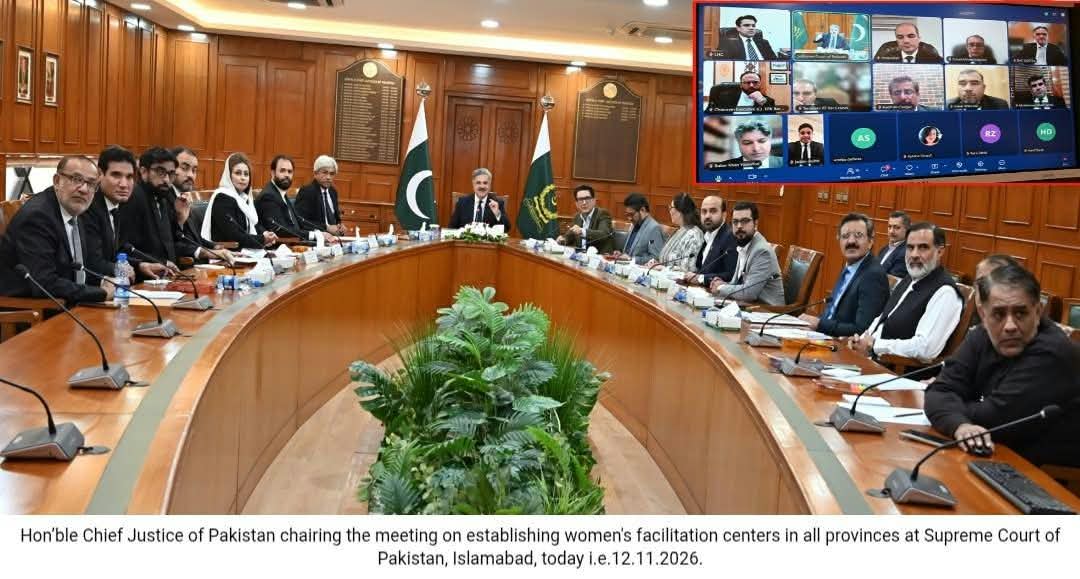
Islamabad, 12 November 2026: The Hon’ble Chief Justice of Pakistan, in his capacity as Chairman of the Law and Justice Commission of Pakistan, today chaired a meeting at the Supreme Court of Pakistan to review progress on the establishment of Women Facilitation Centres across Pakistan. The initial phase will comprise four centres, one in each province, to provide women accessing the justice system with dedicated guidance and support services in a safe, accessible and dignified environment.
The meeting was attended by the Registrar, Supreme Court of Pakistan; Capt. (Retd) Mushtaq Ahmad, Secretary, Law and Justice Commission of Pakistan; Mr. Nasir Khan, Registrar, High Court of Balochistan; Architect Raweeda Himayat, former Chairperson of the Institute of Architects Pakistan (IAP), Islamabad–Rawalpindi Chapter; members of the relevant IAP committees; and NESPAK representatives, including Mr. Faisal Majeed, General Manager, and Mr. Waqar Sheikh. The Resident Additional Secretaries of the Commission in Punjab, Sindh, Khyber Pakhtunkhwa and Balochistan, along with Architect Raza Zahid, Architect Ayesha Yousuf and Architect Hanif Daud, whose designs secured the top three positions in the All-Pakistan Women Facilitation Centre Design Competition, participated via Zoom.
Addressing the participants, the Hon’ble Chief Justice recalled that the judicial facilitation priorities for 2025–26 had focused on four components: uninterrupted electricity supply to courts and Bar associations; e-libraries, including internet facilities; clean drinking water; and women-centric facilities. His Lordship stated that these facilities had been completed and provided to courts and Bar associations across Pakistan, including Islamabad.
The Hon’ble Chief Justice identified the establishment of dedicated Women Facilitation Centres in all four provinces and Islamabad as a priority for 2026–27. The centres are envisaged as a one-window facility to help women obtain information, guidance and assistance without having to approach multiple offices or make repeated visits.
The proposed facilities include reception and guidance desks, comfortable waiting areas, hygienic washrooms, private consultation rooms, legal advice and assistance, and spaces for mediation and alternative dispute resolution. Provision for psychosocial support and referral services would help women facing distress or other vulnerabilities obtain appropriate assistance. Accessible entrances, ramps and clear signage would support women with disabilities, while suitable spaces for dignified visitation and interaction with children would be incorporated where required.
These facilities are intended to address practical barriers that can prevent women from pursuing their legal rights, including unfamiliarity with court procedures, lack of privacy and difficulty accessing advice and support. Bringing essential services together would help women navigate the justice system with greater confidence and dignity.
The Hon’ble Chief Justice informed the meeting that an All Pakistan design competition had been conducted under the auspices of IAP to develop suitable designs for the centres. The three winning designs had been shared with all High Courts to support implementation, taking account of local requirements and the needs of women using the facilities.
The meeting noted that consultations with the relevant High Courts had been completed and space identified for the first four centres, one in each province. These centres will constitute the initial phase of the wider initiative.
The Hon’ble Chief Justice directed NESPAK to commence work on the establishment of the centres. NESPAK and the IAP Islamabad–Rawalpindi Chapter will coordinate on design and implementation, in consultation with the relevant High Courts, to ensure timely completion and adherence to the intended functional requirements.
The initiative forms part of the continuing effort to improve judicial services and make access to justice more responsive to the needs, privacy and dignity of women.
...................................................................................